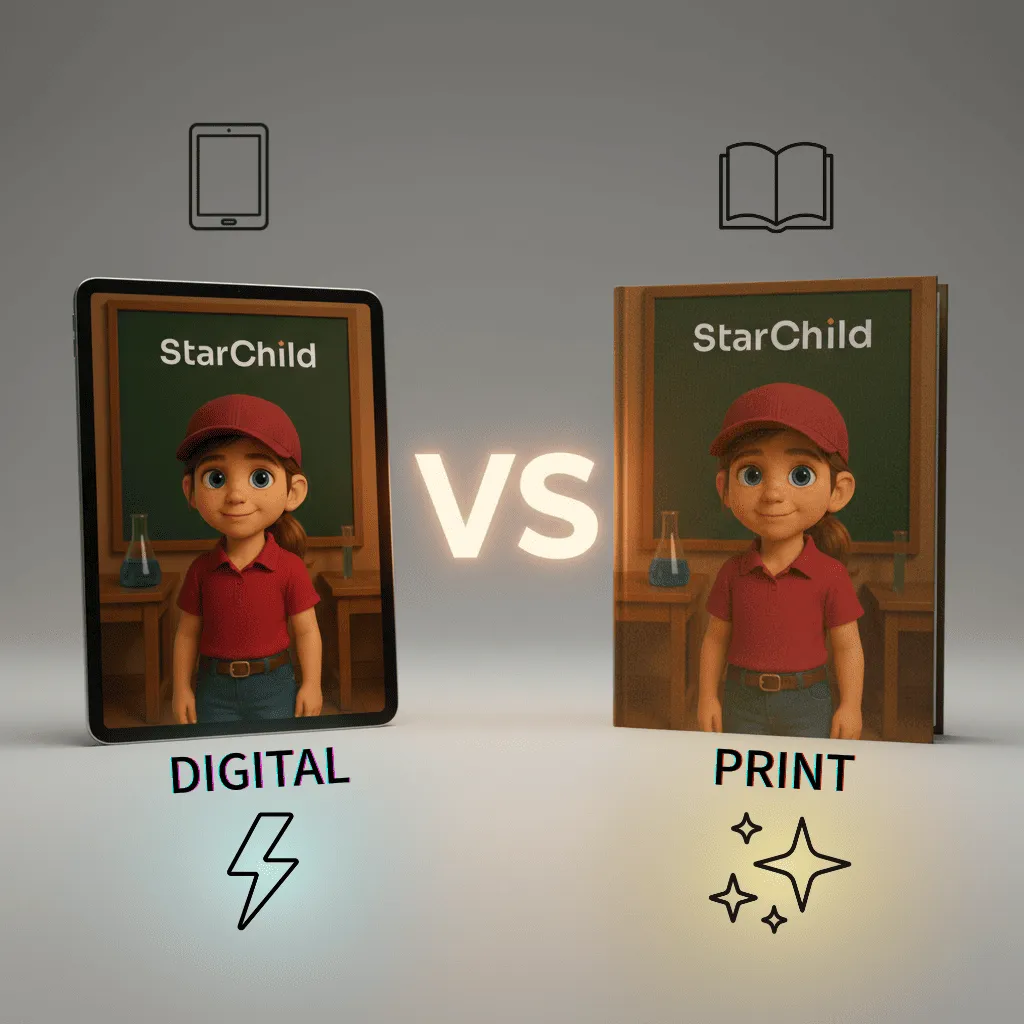

If you're wondering whether reading a StarChild story on an iPad is "as good" as reading the printed book, you're not alone. We hear this a lot from parents who love books and worry about screens.
Short answer: the way you read with your child matters far more than what you read on. Read together, talk about the story, make it a ritual—do that on paper or pixels and you're winning.
What really makes reading "work"
When kids fall in love with stories, it's not because of the material the pages are made of. It's because of:
- Connection (you + your child, together)
- Conversation (questions, predictions, pointing out details)
- Consistency (bedtime rituals, quick reads on the go)
Researchers call this kind of back-and-forth dialogic reading, and it's strongly linked to language growth regardless of whether the book is print or digital. The technique is simple: ask questions, expand on your child's answers, and turn reading into a two-way conversation.
So… do kids comprehend better on paper?
Sometimes, a little—if you compare plain print to busy, distracting e-books. But when the digital book is designed to support the story (gentle prompts, read-aloud features, word highlighting), the gap shrinks or even flips in favor of digital.
A meta-analysis in Review of Educational Research found that when e-books include story-congruent enhancements, they can improve comprehension compared to print.
In a direct test with preschoolers, children reading the same story on an iPad vs. in print were equally engaged; print had only a slight edge on a post-story quiz.
Zooming out, a children-focused meta-analysis of 39 studies reports that differences in comprehension largely depend on digital design features and adult support, not the screen itself.